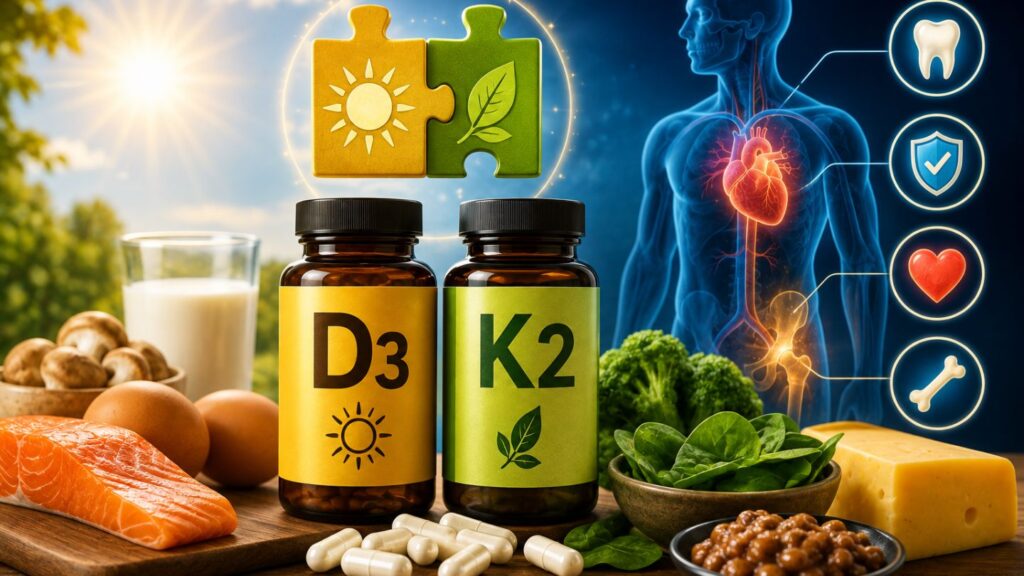
Vitamin D3 and K2 are two fat-soluble vitamins that work synergistically — D3 increases calcium absorption from food, while K2 directs that calcium to bones and teeth rather than arteries and soft tissues. Taking them together prevents the main risk of high-dose Vitamin D supplementation (arterial calcification) and maximizes bone density, heart health, and immune function. Most adults benefit from 2,000–5,000 IU of D3 with 100–200mcg of K2 (MK-7 form) daily.
Introduction
Vitamin D3 and Vitamin K2 are two of the most important yet most misunderstood nutrients in modern nutrition — and their relationship with each other is one of the most significant discoveries in nutritional science of the past two decades.
Most people know that Vitamin D is essential for bone health and immune function. Many have heard that K2 exists. But very few understand that these two vitamins are biologically inseparable — taking one without the other can actually cause harm.
Here is the core problem: Vitamin D dramatically increases your body’s absorption of calcium from food and supplements. This is generally beneficial — calcium is essential for strong bones. But calcium absorbed into the bloodstream needs to go somewhere. Without adequate Vitamin K2, that extra calcium can deposit in arteries, joints, and kidneys — causing cardiovascular disease and kidney stones instead of stronger bones.
K2 is the traffic director. It activates proteins that carry calcium away from soft tissues and into bones where it belongs.
Understanding how these two vitamins work together — and how to supplement them correctly — could be one of the most important steps you take for your long-term health.
What Is Vitamin D3?
Vitamin D3 (cholecalciferol) is the form of Vitamin D produced by your skin when exposed to UVB sunlight, and the form found in animal-based foods. It is the most bioavailable form of Vitamin D — more effective than the plant-based D2 (ergocalciferol) at raising blood Vitamin D levels.
Primary functions of Vitamin D3:
- Regulates calcium and phosphorus absorption in the intestines
- Essential for bone mineralization and density
- Modulates immune system function — activates T-cells and macrophages
- Regulates over 200 genes involved in cell growth, inflammation, and metabolism
- Supports muscle function and reduces fall risk in older adults
- Plays a role in insulin secretion and blood sugar regulation
- Influences mood and mental health via serotonin regulation
Vitamin D3 deficiency is a global epidemic: An estimated 1 billion people worldwide are Vitamin D deficient, and up to 50% of the global population has insufficient levels. This is driven by indoor lifestyles, sunscreen use, darker skin pigmentation, and low dietary intake.
For a complete guide on recognizing deficiency, read our article on the signs of vitamin D deficiency.
What Is Vitamin K2?
Vitamin K2 (menaquinone) is a fat-soluble vitamin that exists in several forms — primarily MK-4 and MK-7. It is distinct from Vitamin K1 (phylloquinone), which is found in leafy greens and primarily involved in blood clotting.
K2 has a completely different role from K1: While K1 is critical for blood clotting, K2 is primarily involved in calcium metabolism — specifically directing calcium to the right places in the body.
Primary functions of Vitamin K2:
- Activates osteocalcin — a protein that binds calcium into bone matrix
- Activates Matrix GLA Protein (MGP) — the most potent inhibitor of arterial calcification known
- Reduces calcium deposits in arteries and soft tissues
- Supports dental health by directing calcium to tooth enamel
- Plays a role in insulin sensitivity and blood sugar regulation
- Emerging research suggests roles in cancer prevention and brain health
Forms of Vitamin K2:
- MK-4: Short-acting, found in animal products (eggs, butter, meat). Half-life of 1–2 hours — requires multiple daily doses
- MK-7: Long-acting, found in fermented foods (especially natto). Half-life of 72 hours — once daily dosing sufficient. Most research-backed form for supplementation
Vitamin K2 deficiency is extremely common in Western diets — the primary food source (natto, a Japanese fermented soybean) is rarely consumed outside Japan, and most people get minimal K2 from other sources.
Why Vitamin D3 and K2 Must Work Together
This is the critical insight that most Vitamin D supplementation guides miss:
The calcium paradox: When you supplement with high-dose Vitamin D3, you significantly increase intestinal calcium absorption. This is the desired effect — more calcium available for bones. But without K2, this extra calcium has nowhere to go except into the bloodstream, where it can deposit in:
- Arteries (arterial calcification — the primary driver of cardiovascular disease)
- Kidneys (kidney stones)
- Joints (calcification contributing to arthritis)
- Breast tissue (soft tissue calcification)
The research: Multiple studies have found that high-dose Vitamin D supplementation without K2 is associated with increased arterial calcification and cardiovascular risk — particularly in people who are K2 deficient (which is most of the Western population).
K2 activates the solution: Matrix GLA Protein (MGP) is the most powerful inhibitor of arterial calcification discovered in the human body. But MGP only works when activated by Vitamin K2. Without K2, MGP remains in its inactive form (ucMGP) — unable to prevent calcium from depositing in arteries.
The synergy in numbers:
- A 2017 study in Thrombosis and Haemostasis found that K2 supplementation reduced arterial stiffness by up to 50% in women with the highest ucMGP levels
- Research shows K2 supplementation increases activated MGP by 25–300% depending on baseline K2 status
- Studies combining D3 and K2 show significantly greater bone density improvements than D3 alone
8 Evidence-Based Benefits of Taking D3 and K2 Together
1. Maximizes Bone Density and Strength
The combination of D3 and K2 produces bone benefits that neither vitamin achieves alone.
How they work together:
- D3 increases calcium absorption from food (by 30–80%)
- K2 activates osteocalcin, which binds calcium into bone matrix
- Together: more calcium absorbed + more calcium deposited into bone = stronger bones
Research: A 3-year randomized controlled trial in postmenopausal women found that the D3 + K2 combination increased bone mineral density at the lumbar spine by 1.7% — compared to no significant change in the D3-only group. Another study found a 25% reduction in fracture risk with combined supplementation.
2. Protects Cardiovascular Health
This is perhaps the most important and underappreciated benefit of K2 — and the main reason to never take high-dose D3 without K2.
The evidence:
- The Rotterdam Study (4,807 participants over 7 years) found that people with the highest K2 intake had a 57% lower risk of dying from cardiovascular disease and a 52% lower risk of severe aortic calcification
- Research consistently shows inverse correlation between K2 intake and arterial calcification
- K2 supplementation (MK-7, 180mcg/day) for 3 years significantly reduced arterial stiffness in healthy postmenopausal women
Why it matters: Arterial calcification — hardening of the arteries from calcium deposits — is one of the strongest predictors of cardiovascular events. K2 is the body’s primary defense against this process.
For more heart health strategies, read our complete guide on how to lower blood pressure naturally.
3. Dramatically Improves Immune Function
Vitamin D3 is arguably the most important nutrient for immune regulation — and its deficiency is directly linked to increased susceptibility to infections, autoimmune diseases, and chronic inflammation.
D3’s immune mechanisms:
- Activates T-cells and macrophages (front-line immune cells)
- Reduces pro-inflammatory cytokines while increasing anti-inflammatory ones
- Maintains the integrity of physical barriers (skin, respiratory mucosa)
- Regulates the innate and adaptive immune response
K2’s immune contribution:
- Emerging research shows K2 reduces inflammatory markers (IL-6, TNF-alpha)
- May play a role in regulating NF-κB — a master controller of inflammation
Research: A meta-analysis of 25 randomized controlled trials found that Vitamin D supplementation significantly reduced the risk of acute respiratory infections — with the greatest benefit in those who were deficient.
For a complete list of immune-supporting nutrients and foods, see our guide on immune-boosting foods.
4. Supports Dental Health
K2’s calcium-directing function extends to teeth — specifically, it activates osteocalcin in the dentin (the inner layer of teeth), supporting tooth remineralization and strength.
How it works:
- K2 activates osteocalcin in dental tissue
- Directs calcium and phosphorus into tooth enamel and dentin
- May support remineralization of early cavity lesions
- K2 deficiency is associated with poor dental enamel formation
Historical evidence: Dr. Weston A. Price’s famous research in the 1930s found that traditional cultures with high K2 intake (from grass-fed animal products) had dramatically better dental health than modernized populations — a finding now understood through the lens of K2 biology.
5. Improves Insulin Sensitivity and Blood Sugar Regulation
Both D3 and K2 independently improve insulin sensitivity — and their combined effect may be particularly significant for metabolic health.
Vitamin D3 and blood sugar:
- Vitamin D receptors are present on pancreatic beta cells (insulin-producing cells)
- D3 supplementation improves insulin secretion in deficient individuals
- Research shows Vitamin D deficiency is strongly associated with insulin resistance and type 2 diabetes risk
Vitamin K2 and blood sugar:
- K2 activates osteocalcin, which acts as a hormone signaling pancreatic beta cells to produce more insulin
- Studies show K2 supplementation improves insulin sensitivity and reduces fasting blood glucose
- A study in Diabetes Care found that higher dietary K intake was associated with a 20% lower risk of type 2 diabetes
6. Supports Muscle Function and Reduces Fall Risk
Vitamin D3 is essential for muscle fiber development and function — deficiency causes muscle weakness, reduced grip strength, and increased fall risk in older adults.
The evidence:
- Vitamin D receptors are present in muscle tissue
- D3 supplementation significantly improves muscle strength and balance
- A Cochrane review found Vitamin D supplementation reduced fall risk by 23% in elderly individuals
- K2 may additionally support muscle energy metabolism through its role in mitochondrial function
Who benefits most: Elderly individuals, athletes, and people with chronic fatigue or unexplained muscle weakness should prioritize D3+K2 supplementation.
7. May Reduce Cancer Risk
Emerging research suggests Vitamin D3 plays a significant role in cancer prevention — and K2 may have independent anti-cancer properties.
Vitamin D3 and cancer:
- D3 regulates cell proliferation and apoptosis (programmed cell death)
- Epidemiological studies consistently show inverse relationship between Vitamin D levels and colorectal, breast, and prostate cancer risk
- A 2019 meta-analysis found Vitamin D supplementation reduced cancer mortality by 16%
Vitamin K2 and cancer:
- K2 has been shown to induce apoptosis in several cancer cell lines in laboratory studies
- A study in the American Journal of Clinical Nutrition found that higher K2 intake was associated with reduced risk of prostate cancer
Note: This is an area of active research — results are promising but not yet definitive clinical recommendations.
8. Supports Brain Health and Mood
Both D3 and K2 have emerging roles in brain health — an area of rapidly growing research.
Vitamin D3 and the brain:
- Vitamin D receptors are found throughout the brain — particularly in areas involved in mood regulation
- D3 deficiency is strongly associated with depression, seasonal affective disorder (SAD), and cognitive decline
- Multiple studies show D3 supplementation improves mood in deficient individuals
- D3 supports serotonin and dopamine synthesis
Vitamin K2 and the brain:
- K2 is found in high concentrations in brain tissue — suggesting an important role
- Activates Gas6 — a protein involved in neuronal survival and myelin formation
- May protect against neurodegenerative diseases through anti-inflammatory and anti-apoptotic mechanisms
Signs You May Be Deficient in Both
Vitamin D3 deficiency signs:
- Frequent illness and infections
- Fatigue and persistent tiredness
- Bone pain and back pain
- Depression or low mood
- Slow wound healing
- Hair loss
- Muscle weakness
Vitamin K2 deficiency signs (less obvious — no classic deficiency disease):
- Arterial calcification (often asymptomatic until advanced)
- Poor bone density / easy fractures
- Dental problems and cavities
- Joint calcification
- Varicose veins
How to test:
- Vitamin D: 25-hydroxyvitamin D blood test — optimal range: 40–60 ng/mL (100–150 nmol/L)
- Vitamin K2: ucMGP test (undercarboxylated Matrix GLA Protein) — less commonly available but accurate
Dosage — How Much D3 and K2 to Take
Vitamin D3 Dosage
| Group | Minimum (RDA) | Optimal (Research-Based) |
|---|---|---|
| Adults (general) | 600–800 IU | 2,000–4,000 IU |
| Adults with deficiency | — | 4,000–10,000 IU (with monitoring) |
| Elderly (65+) | 800 IU | 2,000–5,000 IU |
| Athletes | 600–800 IU | 3,000–5,000 IU |
| Pregnant women | 600 IU | 2,000–4,000 IU |
Upper tolerable limit: 10,000 IU/day for adults (though toxicity is rare below this level)
Test before supplementing: Blood levels vary enormously between individuals. A 25-OH Vitamin D test costs $30–50 and tells you exactly what dose you need.
Vitamin K2 Dosage
| Form | Dosage | Notes |
|---|---|---|
| MK-7 (preferred) | 100–200 mcg/day | Once daily — long half-life |
| MK-4 | 1,500–15,000 mcg/day | Multiple doses needed — shorter half-life |
General rule: For every 1,000 IU of D3, take approximately 50mcg of K2 (MK-7).
| D3 Dose | Recommended K2 (MK-7) |
|---|---|
| 1,000 IU | 50–100 mcg |
| 2,000 IU | 100 mcg |
| 4,000 IU | 150–200 mcg |
| 5,000 IU | 200 mcg |
Best Food Sources
Vitamin D3 Foods
| Food | Vitamin D per Serving |
|---|---|
| Salmon (3 oz cooked) | 570 IU |
| Swordfish (3 oz cooked) | 566 IU |
| Tuna, canned (3 oz) | 154 IU |
| Sardines (2 sardines) | 46 IU |
| Egg yolk (1 large) | 41 IU |
| Beef liver (3 oz) | 42 IU |
| Fortified milk (1 cup) | 120 IU |
| Fortified orange juice (1 cup) | 100 IU |
Sun exposure: 10–30 minutes of midday sun on arms and legs produces 10,000–20,000 IU — by far the most efficient source, but highly variable based on latitude, season, skin tone, and age.
Vitamin K2 Foods
| Food | K2 per Serving | Notes |
|---|---|---|
| Natto (3.5 oz) | 1,103 mcg | Richest source by far |
| Hard cheese (1 oz) | 10–40 mcg | Gouda highest |
| Soft cheese (1 oz) | 5–10 mcg | |
| Egg yolk (1 large) | 5–10 mcg | Grass-fed higher |
| Grass-fed butter (1 tbsp) | 5–10 mcg | |
| Chicken liver (3 oz) | 13 mcg | |
| Grass-fed beef (3 oz) | 5 mcg |
Key insight: Most Western diets provide 10–40 mcg K2 daily — far below the 100–200 mcg associated with cardiovascular and bone benefits in research. This is why supplementation is often necessary.
Should You Add Magnesium to D3 and K2?

Yes — the D3+K2+Magnesium combination is considered the gold standard by many nutrition researchers.
Why magnesium matters:
- Magnesium is required to convert Vitamin D from its storage form to its active form (calcitriol)
- Without adequate magnesium, Vitamin D supplementation is less effective
- Magnesium deficiency is extremely common — estimated 50% of Western populations are deficient
- Magnesium and K2 work together to regulate calcium metabolism
Recommended combination:
- D3: 2,000–5,000 IU
- K2 (MK-7): 100–200 mcg
- Magnesium glycinate or malate: 300–400 mg
This trio — D3, K2, and magnesium — addresses three of the most common nutrient deficiencies in modern populations and covers the complete calcium metabolism pathway.
How to Choose a D3+K2 Supplement
What to look for:
✅ Vitamin D3 (not D2 — D3 is significantly more effective) ✅ Vitamin K2 as MK-7 (not MK-4 alone — MK-7 has longer half-life and more research) ✅ Oil-based capsule — both are fat-soluble and absorb best with fat ✅ Third-party tested — look for USP, NSF, or Informed Sport certification ✅ Combined formula — many reputable brands offer D3+K2 in a single capsule
Red flags: ❌ K2 as MK-4 only — requires multiple daily doses ❌ Tablet form — fat-soluble vitamins absorb poorly without fat ❌ No third-party testing ❌ Very low K2 dose (under 45 mcg) relative to a high D3 dose
When to take it: With your largest meal of the day — fat-soluble vitamins absorb best with dietary fat. Breakfast with eggs, avocado, or nuts is ideal.
For breakfast ideas that support nutrient absorption, see our guide on calcium-rich breakfast foods.
Safety and Interactions
Vitamin D3 safety:
- Generally very safe at doses up to 10,000 IU/day
- Toxicity (hypercalcemia) is rare but possible with very high doses (above 40,000 IU/day for extended periods)
- Symptoms of toxicity: nausea, weakness, frequent urination, kidney pain
- Always test blood levels if taking doses above 5,000 IU daily
Vitamin K2 safety:
- No established upper limit — very low toxicity risk
- Does NOT affect blood clotting at normal doses (unlike K1)
Important drug interaction: Warfarin (blood thinner): Both K1 and K2 can interfere with warfarin’s mechanism. If you are on warfarin or any anticoagulant medication, consult your doctor before taking any Vitamin K supplement.
Other interactions:
- Certain cholesterol-lowering medications (bile acid sequestrants) reduce absorption of fat-soluble vitamins
- Orlistat (weight loss medication) reduces absorption of fat-soluble vitamins
- Glucocorticoids (steroids) interfere with Vitamin D metabolism
Frequently Asked Questions
Q: Can I take Vitamin D3 without K2?
You can — but at doses above 1,000 IU, taking D3 without K2 carries the risk of driving calcium into arteries rather than bones. If you’re taking 2,000 IU or more, K2 supplementation is strongly recommended to direct the extra calcium to bones and away from arteries.
Q: What is the best form of Vitamin K2 — MK-4 or MK-7?
MK-7 is generally preferred for supplementation because it has a much longer half-life (72 hours vs 1–2 hours for MK-4), allowing effective once-daily dosing and maintaining more consistent blood levels. MK-7 from natto has the most research support. Some formulas include both forms.
Q: How long does it take to see results from D3 and K2?
Blood Vitamin D levels typically normalize within 4–8 weeks of consistent supplementation. Bone density improvements take 6–12 months of consistent supplementation. Arterial health improvements (measured by arterial stiffness) have been demonstrated after 3 years of K2 supplementation in studies.
Q: Can I get enough D3 and K2 from food alone?
Food provides meaningful amounts of both — particularly if you eat fatty fish regularly for D3 and fermented foods or grass-fed animal products for K2. However, for most people in Northern latitudes who don’t eat natto, achieving research-backed optimal levels (especially D3 at 40–60 ng/mL) typically requires supplementation.
Q: Should I take D3+K2 with or without food?
Always with food — ideally with a meal containing fat. Both vitamins are fat-soluble and absorb significantly better in the presence of dietary fat. A meal with eggs, avocado, olive oil, nuts, or fatty fish is ideal.
Q: Is Vitamin K2 safe for children?
Yes — K2 is safe for children and important for developing bones and teeth. Dosage should be adjusted for body weight — typically 45–90 mcg MK-7 for children. Consult a pediatrician before supplementing children.
Q: Does K2 cause blood clotting issues?
No — at normal supplemental doses, K2 (MK-7) does not significantly affect blood clotting. This is a common misconception based on confusion with K1, which is involved in clotting. However, if you are on warfarin, consult your doctor before taking any Vitamin K supplement.
Q: Can taking too much Vitamin D cause calcification?
Yes — this is precisely why K2 is essential when taking higher doses of D3. High-dose D3 increases calcium absorption significantly. Without K2 to activate MGP (the arterial calcification inhibitor) and direct calcium to bones, excess calcium can deposit in arteries. The D3+K2 combination prevents this risk.