A multivitamin designed for women over 50 is different from a standard women’s multivitamin in three important ways: it contains more vitamin D and calcium to protect bone density after oestrogen loss, more B12 to compensate for declining stomach acid absorption, and less or no iron because monthly losses stop after menopause. Getting these priorities right on the label is the most useful filter when choosing. This guide explains the nutritional shifts that happen after 50, which nutrients matter most and why, and what to look for — and avoid — on the label.
Key Takeaways
- Vitamin D needs stay at 600 to 800 IU per day but food sources are often inadequate — most women over 50 need a supplement.
- Calcium needs rise to 1,200 mg per day after 50. Multivitamins rarely contain enough; food plus a separate calcium supplement may be needed.
- B12 absorption declines with age. Look for at least 2.4 mcg — some formulators include methylcobalamin (better absorbed than cyanocobalamin) in higher amounts.
- Iron needs drop to 8 mg per day after menopause. Avoid multivitamins with 18 mg of iron unless prescribed — excess iron can cause constipation and, over time, organ stress.
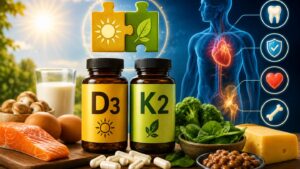
- Vitamin K2 is increasingly included in over-50 formulas because it helps direct calcium into bones rather than arteries.
- No multivitamin replaces a good diet, but it can reliably fill the gaps that are hardest to meet from food alone after 50.
Why Nutritional Needs Change After 50
Menopause, which typically occurs between ages 45 and 55, brings a sharp drop in oestrogen. Oestrogen protects bone density by slowing bone breakdown, so its loss accelerates bone loss and raises the risk of osteoporosis. Oestrogen also affects how efficiently the gut absorbs calcium. Stomach acid production declines with age, reducing absorption of B12 from food. Skin becomes less efficient at synthesising vitamin D from sunlight. These shifts mean that the nutrient gaps most likely to affect women over 50 are specific and predictable.
%3C/text%3E%3Crect x='30' y='150' width='700' height='40' rx='6' fill='%23f8fafc'/%3E%3Ctext x='200' y='175' font-family='Arial,sans-serif' font-size='13' fill='%231f2933' text-anchor='middle'%3EVitamin D%3C/text%3E%3Ctext x='400' y='175' font-family='Arial,sans-serif' font-size='13' fill='%231f2933' text-anchor='middle'%3E600 IU%3C/text%3E%3Ctext x='600' y='175' font-family='Arial,sans-serif' font-size='13' font-weight='bold' fill='%232b7ba3' text-anchor='middle'%3E800 IU over 70 (increase)%3C/text%3E%3Crect x='30' y='194' width='700' height='40' rx='6' fill='%23cfeaf7'/%3E%3Ctext x='200' y='219' font-family='Arial,sans-serif' font-size='13' fill='%231f2933' text-anchor='middle'%3EIron%3C/text%3E%3Ctext x='400' y='219' font-family='Arial,sans-serif' font-size='13' fill='%231f2933' text-anchor='middle'%3E18 mg%3C/text%3E%3Ctext x='600' y='219' font-family='Arial,sans-serif' font-size='13' font-weight='bold' fill='%23c0392b' text-anchor='middle'%3E8 mg (decrease)%3C/text%3E%3Crect x='30' y='238' width='700' height='40' rx='6' fill='%23f8fafc'/%3E%3Ctext x='200' y='263' font-family='Arial,sans-serif' font-size='13' fill='%231f2933' text-anchor='middle'%3EVitamin B12%3C/text%3E%3Ctext x='400' y='263' font-family='Arial,sans-serif' font-size='13' fill='%231f2933' text-anchor='middle'%3E2.4 mcg%3C/text%3E%3Ctext x='600' y='263' font-family='Arial,sans-serif' font-size='13' font-weight='bold' fill='%232b7ba3' text-anchor='middle'%3E2.4 mcg+ (absorption falls)%3C/text%3E%3C/svg%3E)
The Most Important Nutrients in a Multivitamin for Women Over 50
Vitamin D — the Most Consistently Under-Consumed
The NIH RDA for vitamin D is 600 IU per day up to age 70 and 800 IU for those over 70. Research consistently shows that the vast majority of women over 50 do not meet this through food and sun exposure alone. Look for a multivitamin that provides at least 600 to 1,000 IU of vitamin D3 (cholecalciferol — better absorbed than D2). For more on what deficiency looks like and why it matters, see our guide on the 7 warning signs of vitamin D deficiency.
Calcium — Most Multivitamins Do Not Contain Enough
Women over 50 need 1,200 mg of calcium per day. Most multivitamin tablets can only hold 200 to 500 mg of calcium (calcium is a bulky mineral), and the NIH notes that the calcium content in multivitamins is typically low. This means the multivitamin is a starting point, not the whole solution. Check how much calcium you get from dairy, fortified plant milks and leafy greens, and use a separate calcium supplement to fill the remaining gap. Our guide on calcium and magnesium supplement benefits explains how to calculate your gap and which forms absorb best.
Vitamin B12 — Absorption Becomes the Problem, Not Intake
The RDA for B12 remains 2.4 mcg, but the challenge after 50 is not the amount eaten — it is how much is absorbed. Declining stomach acid means less B12 is released from food protein. Crystalline B12 in supplements and fortified foods does not need stomach acid to be absorbed, which is why supplements become more important with age. Look for at least 2.4 mcg; many over-50 formulas include 25 to 100 mcg, which is safe and helps ensure adequacy despite reduced absorption. For a full guide to B vitamins and what they do, see our guide on vitamin B complex benefits for women.
Iron — Choose a Formula Without It (or With Low Amounts)
Iron needs fall from 18 mg to 8 mg after menopause because monthly losses stop. Standard women’s multivitamins formulated for younger women contain 18 mg — twice what most postmenopausal women need. Taking excess iron increases constipation risk and, over time, can lead to iron accumulation. Choose a multivitamin specifically formulated for women over 50 that contains 8 mg or less of iron, or none at all unless a blood test confirms you need more.
Vitamin K2 — Increasingly Included in Over-50 Formulas
Vitamin K2 (menaquinone) helps activate proteins that direct calcium into bones and away from artery walls. Its role becomes particularly relevant after menopause when bone loss accelerates. For more on how vitamin D3 and K2 work together, see our guide on vitamin D3 and K2 benefits.
Magnesium — Often Low in Diets and Multivitamins
Magnesium contributes to bone structure alongside calcium and vitamin D. After 50, the NIH RDA is 320 mg per day for women. Most multivitamins contain only 50 to 100 mg. A varied diet with nuts, seeds, leafy greens and whole grains covers much of the remainder — but many women fall short.
What to Look For on the Label
- Third-party tested: look for NSF Certified for Sport, USP Verified or ConsumerLab approved on the label. These certifications confirm that the product contains what the label says and is free of harmful contaminants.
- Vitamin D3, not D2: cholecalciferol (D3) raises blood levels more effectively than ergocalciferol (D2).
- Methylcobalamin or adenosylcobalamin for B12: both absorb well. Cyanocobalamin is also fine but the other forms are slightly more bioavailable.
- Iron at or below 8 mg: or absent entirely.
- Folate as methylfolate rather than folic acid: particularly useful for women who have a common MTHFR gene variant that reduces folic acid conversion.
- Dose form: two or three capsules daily allows more nutrients per dose than a single tablet, which may be a practical trade-off.
What a Multivitamin Cannot Replace
Multivitamins are gap-fillers, not substitutes for a nutrient-dense diet. A varied diet including plenty of vegetables, legumes, whole grains, lean protein and dairy (or fortified alternatives) covers most micronutrient needs and also provides fibre, phytochemicals and protein that a pill cannot replicate. For practical food-based nutrition ideas that apply to women over 50, see our guide to foods that support overall health.
Frequently Asked Questions
Do women over 50 actually need a multivitamin?
Not everyone does. Women eating a varied diet that includes fortified foods and dairy may meet most needs from food. The nutrients most likely to need supplementing after 50 are vitamin D, calcium and B12. A blood test to check vitamin D and B12 status is a more targeted first step than assuming a multivitamin covers all bases.
Should postmenopausal women take iron?
Generally not, unless a blood test confirms deficiency. The NIH recommends 8 mg per day after menopause, and many women meet this through food without supplementation. Excess iron in supplements is a common source of constipation and is unnecessary once menstrual losses stop.
Is it safe to take a multivitamin and separate calcium and vitamin D?
Yes, provided the combined total of each nutrient stays within the upper tolerable intake levels — 2,000 mg per day for calcium, 4,000 IU per day for vitamin D, 40 mg for zinc. Check the amounts in all supplements you take together to avoid unintentional excess.
Can a multivitamin help with menopause symptoms?
Not directly. Multivitamins address nutritional gaps, not hormonal symptoms like hot flushes or night sweats. Vitamin D and magnesium may support sleep quality and mood as part of overall wellbeing, but they are not a substitute for medical management of significant menopausal symptoms.
Final Thoughts
The best multivitamin for women over 50 is one that addresses the real shifts in nutritional needs that come with menopause and ageing: more vitamin D and calcium for bone protection, adequate B12 in a form the body can absorb without full stomach acid, and significantly less iron. Third-party testing and clear labelling of each nutrient’s elemental amount are the most practical quality filters. A targeted blood test to check vitamin D and B12 levels first gives you a clearer picture of which gaps actually need filling, and a doctor or dietitian can help you interpret the results and choose accordingly.
This article is for educational purposes only and is not a substitute for professional medical advice, diagnosis or treatment.